
At 85 metres, 87 with its weathervane, the Westertoren is the tallest church tower in Amsterdam, and the one Anne Frank could hear from the Secret Annex on the Prinsengracht. Its imperial crown is the landmark of the western canal belt, and the Westerkerk below it is free to enter.
What the Westertoren is
The Westerkerk was commissioned by the city council and built between 1620 and 1631 to a design by Hendrick de Keyser. He died in 1621, and his son Pieter de Keyser finished the job with the city mason Cornelis Dankersz de Rij. The church’s own history calls it the largest Protestant church in the world when it opened, built in the Dutch Renaissance style for a city that had just become rich and wanted to look it.
The tower is the part everyone knows. Completed in 1638, it rises in brick and stone below and wood above to a spire topped by a blue, red and gold imperial crown — the crown from Amsterdam’s coat of arms, a privilege the city traditionally traces back to Emperor Maximilian I. It is not a decoration; it is a piece of civic bragging that has been up there for almost four centuries. The tower still belongs to the City of Amsterdam, not to the church.
Inside the spire hangs a carillon of fifty-one bells. The fourteen largest were cast by François Hemony in 1658, and they still chime the hours over the Jordaan. Anne Frank wrote about them from the annexe at Prinsengracht 263, a few doors up the canal: the others found the chiming hard to get used to, but she liked it from the start and found it reassuring, especially at night.
| Westertoren and Westerkerk | |
|---|---|
| Address | Prinsengracht 279–281, 1016 GW Amsterdam (visitor entrance at number 279) |
| Height | 85 metres, 87 with the weathervane — the tallest church tower in the city |
| Built | Church 1620–1631, tower completed 1638, to designs by Hendrick de Keyser |
| Owner of the tower | The City of Amsterdam |
| Church opening hours | Monday to Friday 11:00–15:00, and also on Saturdays in July and August. Free entry |
| Closures | The church closes to visitors for services, weddings, concerts and other events |
| Carillon | 51 bells; the 14 largest cast by François Hemony in 1658. Concerts usually on Tuesdays 12:00–13:00 |
| Buried here | Rembrandt van Rijn, 8 October 1669; the exact spot is unknown |
| Getting there | Tram 2, 17 or 24 to Paleisstraat or Dam, or tram 5 to Bloemgracht. Ten minutes on foot from Dam Square |
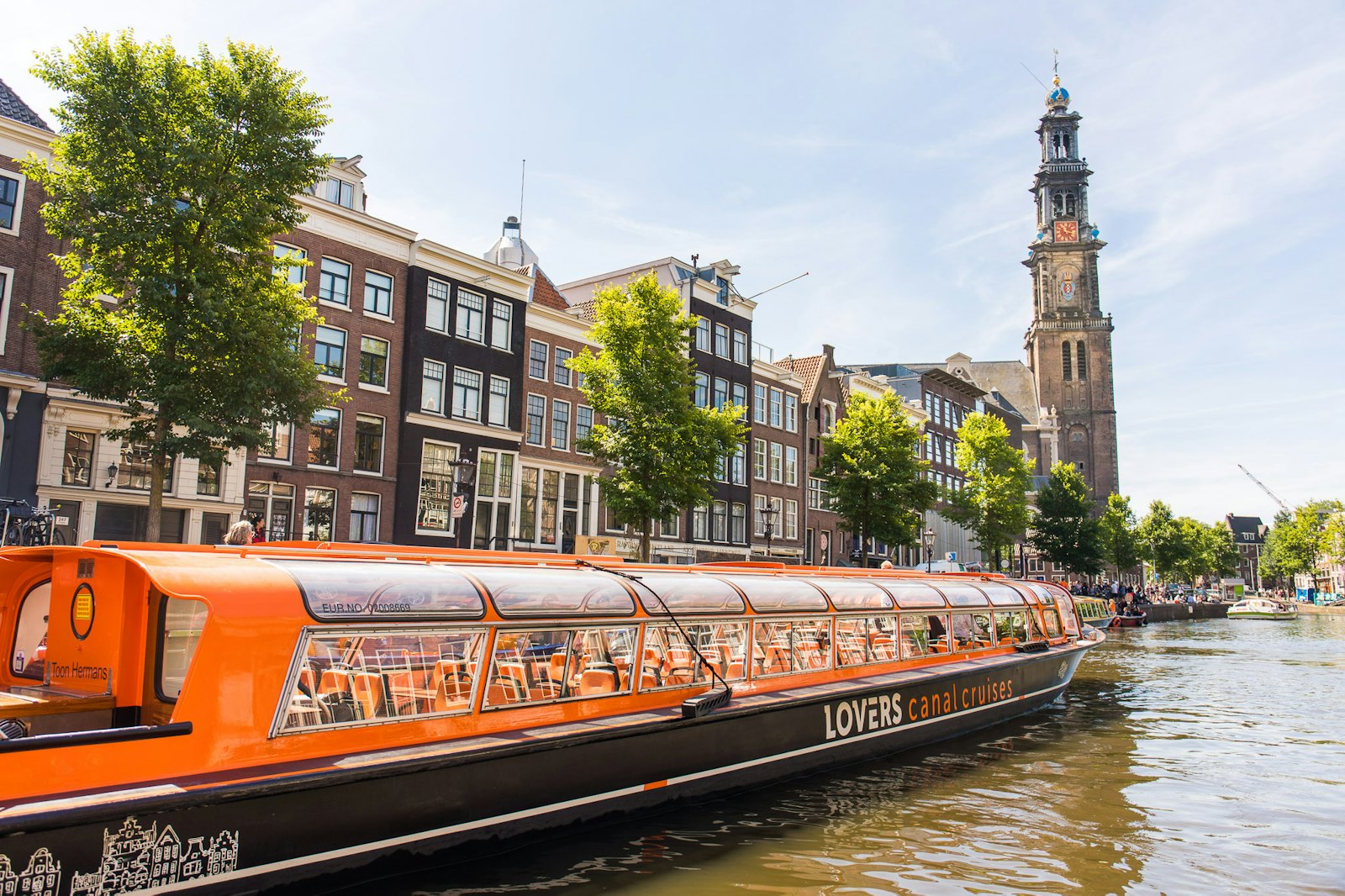
The view of the tower, and from it
The Westertoren is at its best from below. It closes the view along the Prinsengracht, rises above the rooftops of the Jordaan and turns up in the background of almost every photograph taken around the Anne Frank House. A few places to see it properly:
- From the water — a canal cruise along the Prinsengracht passes right under it, and the tower is the clearest landmark on the western side of the canal belt.
- From the Westermarkt — the square beside the church, where you can stand at the foot of the tower and hear the bells.
- From the Leliegracht and the Bloemgracht — the small cross canals either side, where the spire appears over the gables.
- A’DAM Lookout — across the IJ, five minutes by free ferry from Central Station, and the highest public viewpoint in the city, with the old centre’s towers laid out below.
- The Oude Kerk — the oldest building in Amsterdam, whose own tower looks out across the Red Light District towards the canal belt.
The view from the tower itself takes in the whole canal belt, the Jordaan and the IJ. Check the official Westerkerk website for current tower-tour availability.
Inside the Westerkerk
The church is open on weekdays and costs nothing. It is worth twenty minutes.
- Rembrandt’s grave — he lived on the Rozengracht near the church at the end of his life and was buried here on 8 October 1669, in a rented grave. Nobody knows exactly where he lies. A memorial plaque from 1909 hangs on the north wall, and his son Titus and his partner Hendrickje Stoffels were buried here too.
- The interior — Protestant, light and deliberately plain, which is the point: this was built as a preaching church, not a shrine. The seventeenth-century pulpit stands where the two crosses of the floor plan meet, under twelve copper chandeliers bearing the city arms. The scale is what impresses.
- The organs — the great Duyschot organ, commissioned in 1681 and finished in 1686, with shutters painted by Gerard de Lairesse showing King David and the Queen of Sheba’s visit to Solomon. A smaller choir organ by Flentrop dates from 1963.
- The carillon concert — usually on Tuesdays from noon to one, played from inside the tower and heard across the whole Jordaan. You do not need a ticket; you just need to be standing on the Westermarkt.
Outside on the Westermarkt are two things people walk past: the Homomonument, the first monument in the world to gay men and women persecuted for their sexuality, and the small statue of Anne Frank beside the church.
Visiting and getting there
- Entry to the church is free, but there is a donation box and it is a working congregation, not a museum. The visitor entrance is at Prinsengracht 279.
- The church is open to visitors from 11:00 to 15:00, Monday to Friday, and also on Saturdays in July and August. It closes for services, weddings and concerts, so check before making a special trip.
- The Anne Frank House is a few doors up the same canal. Combine them; the tower is in every photograph you will take there.
- By tram, the nearest stops are Paleisstraat and Dam (trams 2, 17 and 24) and Bloemgracht (tram 5). From Dam Square it is a ten-minute walk west, past the Royal Palace and through the Nine Streets.
- This is the edge of the Jordaan, so it works as the start of a walk rather than a destination in itself.
The rest of the city’s paid and free sights are listed on our Amsterdam attractions page.
Frequently asked questions
The tower is 85 metres high, or 87 metres including the weathervane, which makes it the tallest church tower in Amsterdam. It was completed in 1638 and is owned by the City of Amsterdam.
It is the imperial crown from the coat of arms of Amsterdam. By tradition the right to carry it was granted to the city by Emperor Maximilian I in the late fifteenth century, and the blue, red and gold crown on the spire is the most visible version of it in the city.
Yes. Entry is free and donations towards the upkeep are welcome. The church is open to visitors from Monday to Friday, 11:00 to 15:00, and also on Saturdays in July and August. It closes for services, weddings and events.
Yes. Rembrandt was buried here on 8 October 1669, in a rented grave, and the exact spot is no longer known. A memorial plaque from 1909 hangs on the north wall. His son Titus and his partner Hendrickje Stoffels were also buried in the church.
The Secret Annex at Prinsengracht 263 is a few doors up the same canal. Anne Frank wrote about the chiming of the Westertoren clock in her diary: the others found it hard to get used to, but she liked it from the start and found it reassuring, especially at night.
The carillon of 51 bells chimes the hours, and the city carillonneur usually gives an hour-long concert on Tuesdays from 12:00 to 13:00. You hear it best from the Westermarkt or the Prinsengracht.


