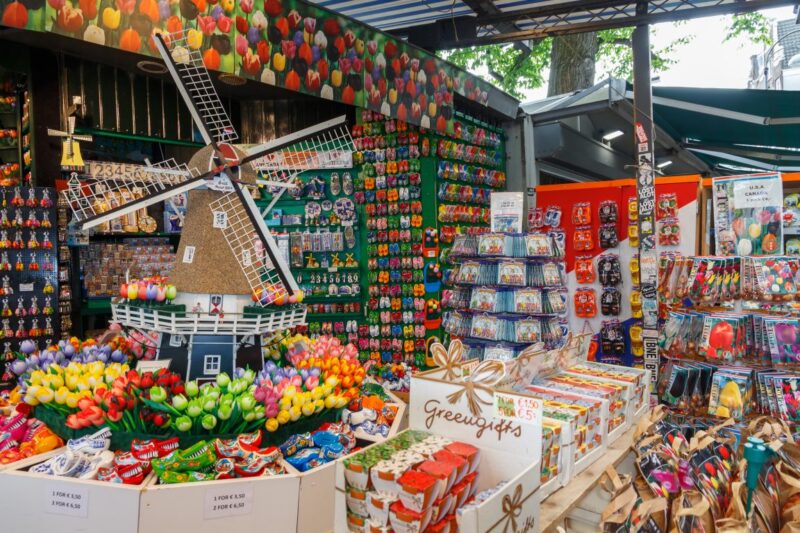
The flower market on the Singel has been there since 1862 and is free to walk through, which are the two best things about it. It is also, honestly, no longer much of a flower market: fifteen or sixteen stalls, mostly souvenirs and packaged bulbs, and the last florist who made bouquets to order gave up in 2019. Worth ten minutes on your way somewhere else — and worth reading the section on bulbs before you buy any.
What the Bloemenmarkt is
The market dates from 1862, when growers brought flowers into the city by water and sold them straight off the boats moored along the Singel. That is the origin of the phrase you will see everywhere: the world’s only floating flower market.
It is worth being precise about that claim, because it is half true. The stalls do stand over the water rather than on the quay — they sit on fixed pontoons along the canal wall, with the shop front on the street side and the greenhouse end hanging over the Singel. What they no longer do is float in and out. The boats stopped coming a long time ago, and the real flower trade moved to the auction halls at Aalsmeer, which handle a large share of the world’s cut flowers and are nowhere near here.
So: a historic market, in a genuinely unusual position on the water, that has been overtaken by the tourist trade. Both halves of that are true, and most descriptions only give you the first one.
| Bloemenmarkt | |
|---|---|
| Address | Singel, between Muntplein and Koningsplein, 1017 AZ Amsterdam |
| Opening hours | Monday to Saturday 9:00–17:30, Sunday 11:00–17:30 |
| Price | Free — it is a street market, not an attraction |
| Founded | 1862 |
| Stalls | Around fifteen, of which only a couple still sell fresh flowers |
| How long | Ten to fifteen minutes |
| Best time | Early morning, before the tour groups. It is narrow and it fills up |
| Getting there | Tram 2, 12 or 14 to Koningsplein, or metro 52 to Rokin, five minutes on foot |
| Also here in December | Christmas trees, which is when locals still come |
What is actually sold there
Stall by stall, roughly in order of how much shelf space it takes up:
- Packaged flower bulbs — tulips, daffodils, crocus, amaryllis, in printed bags aimed squarely at visitors. This is the bulk of the market. See the next section before buying.
- Wooden tulips — painted, indestructible, and the single most-sold object on the Singel.
- Souvenirs — clogs, magnets, cheese, delftware, stroopwafels. Amsterdam’s own market rules cap non-plant goods at a quarter of a stall’s space, and that cap is not enforced.
- Seeds and starter kits — cannabis seeds are sold openly at several stalls, which surprises people. They are legal to sell here and illegal to import almost everywhere else.
- House plants and cut flowers — still there, at one or two stalls, and perfectly good if you actually want flowers today.
- Christmas trees — from late November, and the one time of year the market serves the neighbourhood rather than the visitor.
The turning point is documented. In 2019 Michael Saarloos, whose family had sold flowers on the Singel since 1943, closed the last stall making bouquets to order, saying the tour groups had made it impossible to serve customers. Fifteen stalls remain; the trade behind them has changed.
Buying bulbs: read this first
This is the part worth knowing, and almost nobody tells you.
Bulbs sold here are often kept and re-sold all year round, and a bulb out of the ground that long loses the strength to flower. Sample tests by the Dutch bulb trade organisations Anthos and the KAVB found that of sixty tulip bulbs bought on the market, one bloomed. Amsterdam’s own broadcaster looked into it and found that nobody inspects the quality: the district said it was the food and product authority’s job, the authority said it only checks for plant disease, and the consumer authority suggested the city simply warn visitors. Nothing changed, because the customers are tourists who are back home by the time the bulb fails to come up.
None of that makes the market a scam to walk through. It does mean you should treat the bulb bags as souvenirs rather than as gardening.
- If you want bulbs that flower, buy from a grower or a garden centre in season — autumn, for spring bulbs — rather than from a market bag in July.
- If you are taking them home outside the EU, you need bulbs certified for export with a phytosanitary certificate. The United States, Canada, Australia and New Zealand all require it. Ask to see the certificate; do not rely on a sticker saying the bag is approved.
- Check the packaging date and the bulb itself. A good bulb is firm and heavy for its size, with the papery skin intact. Soft, light or shrivelled means it has been on a shelf too long.
- Buy the wooden tulips instead if what you actually want is something tulip-shaped to take home. They are honest about what they are.
Practical points
- It is free and it is outdoors, so there is nothing to book and no reason to plan around it.
- The strip is one narrow pavement between Muntplein and Koningsplein. Mid-afternoon it is shoulder to shoulder; at nine in the morning it is pleasant.
- It is a two-minute walk from the Kalverstraat and five from the canal district, so it fits naturally into a walk rather than a trip of its own.
- For a market where Amsterdammers actually shop, the Albert Cuyp in De Pijp and the Waterlooplein flea market are both better. Our guide to Amsterdam markets covers all of them.
- Prices are not fixed and are aimed at visitors. Compare two stalls before you buy anything.
- December is the one month worth going out of your way for, when the Christmas trees arrive and the market briefly belongs to the neighbourhood again.
Frequently asked questions
Yes. It is a public street market on the Singel, open to walk through at no charge, Monday to Saturday from 9:00 to 17:30 and Sunday from 11:00 to 17:30.
Partly. The stalls stand on fixed pontoons along the canal wall, so they are over the water rather than on the quay. They no longer arrive by boat, as they did when the market started in 1862.
Often not. Sample tests by the Dutch bulb trade bodies Anthos and the KAVB found that only one in sixty tulip bulbs bought on the market flowered, and no authority inspects the quality. Treat the bags as souvenirs, and buy from a grower or garden centre if you want bulbs that grow.
Only bulbs certified for export with a phytosanitary certificate. The same applies to Canada, Australia and New Zealand. Ask the seller to show you the certificate rather than trusting a printed sticker.
Ten to fifteen minutes. It is one narrow strip of about fifteen stalls between Muntplein and Koningsplein.
Barely. Most stalls now sell packaged bulbs, wooden tulips and souvenirs, and the last florist making bouquets to order closed in 2019. One or two stalls still sell fresh flowers and plants.


