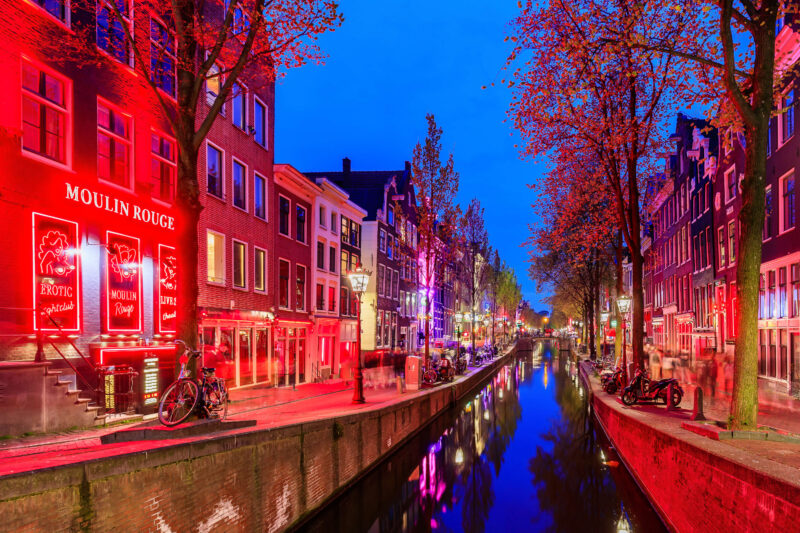
Amsterdam’s red light district, known as “De Wallen“, is one of the city’s most famous and controversial areas. Located in the heart of old Amsterdam, it is both a bustling tourist attraction and a business hub for people involved in the sex trade. To truly understand this district, it is essential to delve into its history and understand its current function in the context of contemporary Amsterdam.
De Wallen at a glance
| Where | Between the Oudezijds Voorburgwal and the Oudezijds Achterburgwal, in the oldest part of Amsterdam’s city centre |
| From Centraal Station | About 5 minutes on foot along the Damrak and the Warmoesstraat |
| Tram | Line 2, stop Nieuwezijds Kolk or Dam |
| Metro | Nieuwmarkt station, about 3 minutes on foot |
| Nearest cruise pier | In front of Centraal Station and along the Damrak — the closest canal cruise departure points in the city |
| What it costs | Nothing. Walking through De Wallen is free; only tours, museums and shows are paid |
| Best time to go | Early evening for the atmosphere, weekday mornings for the architecture and the quiet canals |
De Wallen is built around two canals, and that is the easiest way to understand it. The Oudezijds Voorburgwal and the Oudezijds Achterburgwal run parallel through the district, and almost everything worth seeing sits on or between them. Walk the canals rather than the alleys and you see the medieval city that the neon usually hides.
History of the Red Light District
The history of the Wallen dates back to the Middle Ages. Amsterdam, with its strategic location as a port city, grew rapidly in importance in the 13th and 14th centuries. Sailors docking at the port sought entertainment after long journeys, which led to the area’s emergence as a centre for adult entertainment. Over time, the district became institutionalised, with brothels and other establishments settling in the maze of narrow streets and canals.
The name “Red Light District” is attributed to the red lights traditionally used to indicate brothels. These lights were a discreet signal to potential customers and ensured that the nature of the business was clear.
From tolerance to regulation
Amsterdam has always been known for its liberal and tolerant attitude and this also applied to its views on prostitution. Although selling sex was not always legal, it was often tolerated by the authorities as long as it was done discreetly.
By the end of the 20th century, however, the Red Light District had become a bone of contention. Concerns about human trafficking, drug abuse and the welfare of sex workers led to calls for more regulation. In 2000, the Dutch government legalised brothels and introduced regulations to make the industry safer for all involved. Mandatory regular health checks for workers, licensing requirements for brothel owners and strict rules to combat human trafficking were among the many initiatives introduced.
The red light district today
Today, the Red Light District remains an important part of Amsterdam’s identity. It is a mix of commerce, culture and controversy. By day, it is an area with historic buildings, canals and even churches. At night, the red lights glow and attract visitors from all over the world.
Her current role can be categorised as follows:
- Tourist attraction: Many visitors come out of sheer curiosity. Guided tours offer insights into the history and operation of the district. However, there are concerns about “touristisation”, where the large number of visitors could disrupt normal activities in the area.
- Sex workers: Besides window brothels, there are many sex shops, theatres and peep shows in this area. Workers here have the legal right to ply their trade and are protected by regulations.
- Cultural significance: The Red Light District is not just about the sex trade. It is a historic area with its own unique cultural significance. The Oude Kerk, Amsterdam’s oldest building, testifies to the area’s rich history. The ‘Our Lord in the Attic Museum‘ is also a must visit.
- Reforms and changes: Due to concerns about crime, human trafficking and the overall image of the city, there have been discussions about reducing the number of window brothels or even moving the neighbourhood elsewhere. Some initiatives have also sought to diversify the type of businesses in the area by promoting art galleries, boutiques and other establishments.
In conclusion, Amsterdam’s Red Light District, with its rich history and complex dynamics, serves as a testament to the city’s ever-changing balance between liberal values and the challenges of modern urban life. Although the future of The Red Light District in its current form remains uncertain, its cultural and historical importance cannot be denied.
Opening hours of the Red Light District
The Red Light District, also known as De Wallen, has no specific “opening hours” like a shop or museum has. However, the activities and businesses in the Red Light District do have general opening hours.
- Window brothels: Sex workers usually start appearing in windows early in the afternoon, around 2 or 3 pm, and may stay until the early hours of the morning. Peak hours are usually late in the evening, after 11pm.
- Bars and pubs: These open late in the morning or early in the afternoon and close sometime between midnight and 3am, depending on the specific establishment and the day of the week.
- Sex shops and theatres: These generally open late morning or early afternoon and may stay open until midnight or later.
- Coffee shops: Amsterdam’s famous “coffee shops” (where cannabis is sold) usually open in the morning, around 10 or 11am, and close around midnight, although this can vary.
- Tours: Tours of the Red Light District usually take place in the late afternoon or early evening to cater to tourists. Some also offer night tours.
- Restaurants: Many restaurants in the area are open for lunch and dinner, and some stay open until late in the evening.
It is important to note that the specific hours may vary depending on the business, the day of the week and the season. Moreover, the atmosphere and type of activity change from day to night, as in any city neighbourhood.
FAQs about the Red Light District in Amsterdam
Staying here
Booking.com currently lists 43 places to stay in this district. Staying inside the neighbourhood you came for saves you the two tram rides a day that eat into a short trip.
- Browse hotels in this district — Count from Booking.com, August 2026. The link carries our partner code and costs you nothing extra.
It is a part of the centre of Amsterdam mainly known for its window brothels where sex workers offer their services. The district also has sex shops, peep shows, bars and coffee shops.
Yes, prostitution is legal in the Netherlands. However, it is regulated and sex workers must abide by specific rules and undergo regular health checks.
Red lights are traditionally used to indicate rooms where sexual services are offered. It is a discreet way of communicating the nature of the business inside.
Although there is no age restriction to walk through the district, many establishments (such as sex shops or shows) have an age limit, often 18 years or older.
In general, the district is safe, especially during the day. But as in any busy tourist area, it is important to watch out for pickpockets and avoid getting involved in illegal activities.
Taking photos of sex workers is strictly forbidden and considered disrespectful. Although you can take photos of other parts of the neighbourhood, you should always be mindful of people’s privacy.
Yes, there are tours available that provide insight into the history and workings of the district. Some focus on the history, while others look at the reality of the sex industry in the Netherlands.
The Dutch government has introduced strict rules to combat human trafficking. Brothels need a licence to operate and there are regular checks to ensure the safety of workers.
The future of The Red Light District has been a topic of discussion. Due to concerns about the impact on the city’s image, human trafficking and overcrowding, there has been talk of reducing the number of window brothels or even moving parts of the district elsewhere.
While prostitution is an important aspect, the area is also rich in history and culture. There are several establishments, including bars, restaurants, shops and historical sites such as the Old Church.
Map of the canal district in Amsterdam
You will never be bored in the canal district of Amsterdam. The many shops, restaurants, hotels, attractions and museums ensure that both young and old are entertained. There are also many activities to undertake on or along the canals. Use the map below to explore the canal area. What are you going to do in Amsterdam?
What to book from De Wallen
De Wallen sits right next to the busiest canal cruise piers in Amsterdam. From the district you are a few minutes’ walk from the departure points in front of Centraal Station and along the Damrak, which makes it the easiest place in the city to combine a walk through the old centre with an hour on the water.
Read more: our full guide to hotels in this district.
- Canal cruise from Centraal Station — the closest departure point, about 5 minutes from De Wallen.
- Evening canal cruise — the canals of the old centre lit after dark, which is when this part of town is at its best.
- Lovers canal cruise from Central Station — the classic one-hour loop, leaving every 15 minutes, with an audio guide in 19 languages.
- Hop on hop off canal cruise — stops near De Wallen and continues to the Rijksmuseum and the Anne Frank House.
Around De Wallen
- The canal district — how the UNESCO canal belt around the old centre was built and what to see on each canal.
- Tram line 2 — stops at Nieuwezijds Kolk on the edge of De Wallen and runs on to the Dam, Leidseplein and the Museumplein.
- Map of the canal district — where De Wallen sits in relation to the canal belt.
- The Nine Streets — across the canal belt to the west, nine streets of small shops and cafés.
- The Jordaan — the working-class quarter west of the Prinsengracht, with markets and hofjes.
- The Kalverstraat — the main shopping street from Dam Square to the Munt, with the Begijnhof and a free hidden church opening off it.
- Metro line 52 — the Noord/Zuidlijn, under the old city in fifteen minutes, with a free archaeological display inside Rokin station.


