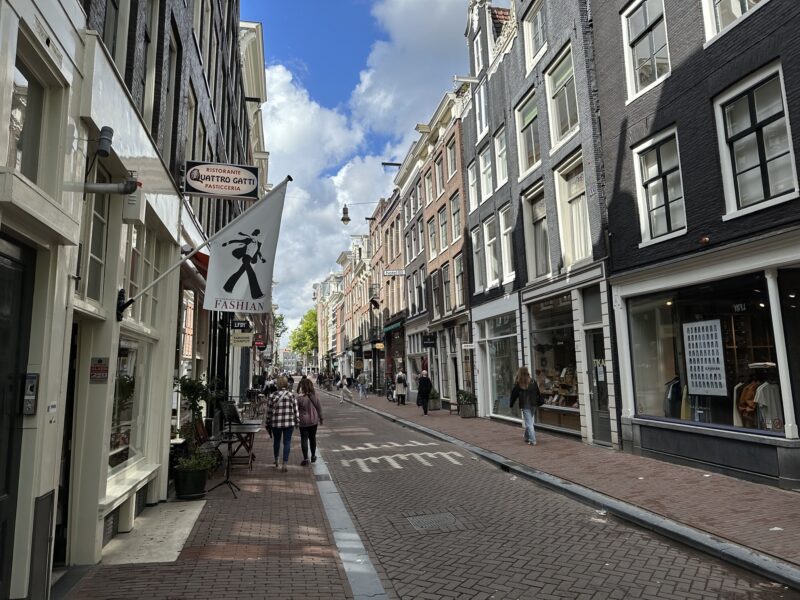
The Nine Streets are nine short side streets that cross the Singel, the Herengracht, the Keizersgracht and the Prinsengracht in the middle of Amsterdam’s canal belt. They run between the Raadhuisstraat in the north and the Leidsegracht in the south, and hold more than 140 listed monuments alongside a dense run of small shops, cafés and galleries. Walking all nine takes about an hour.
The Nine Streets at a glance
| Where | Nine cross-streets over the Singel, Herengracht, Keizersgracht and Prinsengracht, in the heart of the UNESCO canal belt |
| Boundaries | Raadhuisstraat to the north, Leidsegracht to the south |
| From Centraal Station | About 15 minutes on foot, or tram 2 to the Keizersgracht stop |
| Tram | Line 2, stop Keizersgracht |
| By car | Parking in the streets themselves is scarce and expensive. Q-Park Europarking on the Marnixstraat (number 250) is about ten minutes away on foot. |
| On the water | Canal cruises pass through all four canals the streets cross; the nearest departure points are at Centraal Station and on the Prinsengracht |
| What it costs | Nothing to walk. Most shops open from 10 or 11 in the morning |
| Best time to go | Weekday mornings, when the streets are quiet and the light is on the canal houses |
Which nine streets, and between which canals
The simplest way to understand the area is as three rows of three. Each row connects a different pair of canals, so every street you turn into brings you one canal further from the centre.
| Between | |||
|---|---|---|---|
| Prinsengracht → Keizersgracht | Reestraat | Berenstraat | Runstraat |
| Keizersgracht → Herengracht | Hartenstraat | Wolvenstraat | Huidenstraat |
| Herengracht → Singel | Gasthuismolensteeg | Oude Spiegelstraat | Wijde Heisteeg |
Why they are called that
The names come from the leather trade that once worked here: ree (roe deer), beer (bear), wolf and huiden (hides). Tanners and skinners needed water on both sides, and these short streets between the canals were exactly that. Most of the buildings you see today date from the eighteenth century, and the area counts over 140 national and municipal monuments — which is why the shopfronts are small and the facades above them are not.
Shops and cafés
The nine streets are almost entirely independent traders: small boutiques, vintage and second-hand clothing, design and interiors, and specialist food shops, with a café or lunchroom on most corners. De Kaaskamer on the Runstraat has sold cheese here for decades and is the easiest landmark to steer by. Because the shopfronts sit in eighteenth-century canal houses, the units are narrow — expect one room deep rather than a department store.
Museums and culture
Two buildings on the Keizersgracht are open to visitors and deserve a place in your route rather than a glance from the pavement.
- Huis Marseille, Keizersgracht 401 — the first museum in the Netherlands devoted entirely to photography. It occupies two seventeenth-century canal houses, ceiling paintings and a hidden garden included. Open 10:00–18:00, and until 21:00 on Thursdays.
- Felix Meritis, Keizersgracht 324 — opened in 1788 as a society for the arts and sciences, the Temple of Enlightenment. Today it is a venue for debates, concerts and conferences, and the eighteenth-century rooms are part of the draw.
- The Museum of the Canals sits a few minutes east on the Herengracht, at the edge of the area.
What to book from the Nine Streets
You are standing on the canal belt itself here. The Museum of the Canals sits on the Herengracht at the eastern end of the area, and every canal cruise in the city passes underneath the bridges you are crossing.
- Museum of the Canals — on the Herengracht, the story of how these four canals were dug and who paid for them.
- Lovers canal cruise from Central Station — the classic one-hour loop, leaving every 15 minutes, with an audio guide in 19 languages.
- Evening canal cruise — the canal houses lit from the water after the shops close.
- Rent a boat yourself — steer your own tender through the Keizersgracht and Prinsengracht.
Staying here
Booking.com currently lists 20 places to stay in this district. Staying inside the neighbourhood you came for saves you the two tram rides a day that eat into a short trip.
- Browse hotels in this district — Count from Booking.com, August 2026. The link carries our partner code and costs you nothing extra.
Nine short side streets that cross the Singel, Herengracht, Keizersgracht and Prinsengracht in the canal belt, between the Raadhuisstraat and the Leidsegracht. They are known for small independent shops, cafés and galleries in eighteenth-century canal houses.
Reestraat, Berenstraat and Runstraat between the Prinsengracht and the Keizersgracht; Hartenstraat, Wolvenstraat and Huidenstraat between the Keizersgracht and the Herengracht; Gasthuismolensteeg, Oude Spiegelstraat and Wijde Heisteeg between the Herengracht and the Singel.
Take tram 2 from Centraal Station to the Keizersgracht stop, or walk from the station in about fifteen minutes via the Dam and the Raadhuisstraat.
About an hour to walk all nine without stopping. Most visitors spend two to three hours because of the shops and cafés.
No. The Nine Streets lie east of the Prinsengracht, inside the canal belt. The Jordaan starts on the other side of that canal.
Most open from 10 or 11 in the morning and close around six. Sundays are shorter and some shops stay closed on Monday mornings.
Around the Nine Streets
- The canal district — the four canals the nine streets cross, and how the belt was laid out.
- Tram line 2 — stops at the Keizersgracht, right at the eastern edge of the area.
- The Red Light District — the older, medieval part of the centre, about ten minutes east.
- Map of the canal district — where the Nine Streets sit within the canal belt.
- The Kalverstraat — the main shopping street from Dam Square to the Munt, with the Begijnhof and a free hidden church opening off it.
- Museumplein — the museum square with the Rijksmuseum, Van Gogh, Stedelijk and Moco, fifteen minutes south by tram 2 or 5.
Read more: our full guide to hotels in this district.


