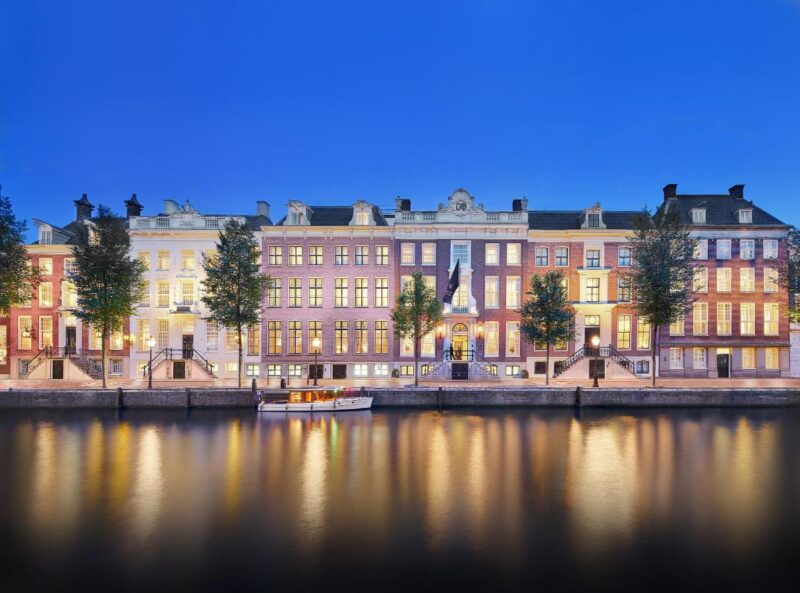
Sleeping on the canal belt means waking up on the Herengracht, Keizersgracht or Prinsengracht — the seventeenth-century ring that is the reason most people come to Amsterdam. There are 139 places to stay inside it, many of them in the canal houses themselves, and almost everything in the centre is within twenty minutes on foot.
Who this area suits
The canal belt is the compromise that works for most visitors. It is central without being the tourist crush of the Damrak, quiet at night because there is little nightlife on the water itself, and close enough to walk to the Rijksmuseum in one direction and Central Station in the other. What you pay for is the address: a room in a canal house on the Herengracht costs more than the same room three streets west.
The catch is the buildings. Seventeenth-century canal houses are tall and narrow, which is why so many of them have steep stairs and no lift, and why rooms at the front look out over water while rooms at the back look at a courtyard. If stairs are an issue, ask before you book — the hotel will tell you, but not always on the booking page.
| Accommodation in this district | 139 properties |
| Booking.com district | Canal Belt / Grachtengordel |
| Walk to Central Station | 15 to 25 minutes |
| Walk to the Rijksmuseum | 10 to 20 minutes |
| Best for | First visits, couples, anyone who wants the view |
| Less good for | Travellers with heavy luggage or limited mobility |
Three hotels that show what the canal belt is
These are not the cheapest rooms in Amsterdam. They are the ones that explain why people pay for this address.
Waldorf Astoria Amsterdam
Herengracht 542–556
Six monumental canal palaces from the seventeenth and eighteenth century, knocked into one hotel. The staircase is attributed to Daniel Marot, the architect who worked for Louis XIV and then for the Dutch court.
Andaz Amsterdam Prinsengracht
Prinsengracht 587
Amsterdam’s former public library, now a hotel. A rare canal-belt building that is wide rather than tall, which is why the ground floor feels nothing like a canal house.
The Toren Amsterdam by The Pavilions
Keizersgracht 164
Two seventeenth-century canal houses that once belonged to trade merchants, on the quiet stretch of the Keizersgracht north of the Westerkerk.
How much choice you have
139 properties is the second-largest supply in the centre after the old town, and it is spread across the full width of the ring, from the Brouwersgracht in the north to the Amstel in the south. That matters more than the number: the northern end near the Jordaan is quieter and cheaper than the stretch around the Leidsestraat, and both count as the canal belt.
Compare what is available: all 139 places to stay on the canal belt.
Getting around from here
- Almost everything in the centre is walkable. That is the point of staying here.
- Tram 2 and tram 12 cross the ring towards Museumplein; the tram 2 route is the scenic one.
- Central Station is 15 to 25 minutes on foot, or two stops on almost any tram.
- A canal cruise stop is never far: most departure points are on or beside the ring.
What is around you
The Nine Streets cut through the middle of the ring and are the best shopping in walking distance. The Jordaan starts on the far bank of the Prinsengracht. The Museum of the Canals is on the Herengracht and explains what you are looking at.
Frequently asked questions
For a first visit, yes. It is central, quiet at night, and you can walk to most of what you came for. It is not the cheapest part of the city.
Booking.com lists 139 properties in the Canal Belt district, from single canal houses to larger hotels spread over several buildings.
Many of the smaller ones do not. Seventeenth-century canal houses are narrow and steep, and a lift often does not fit. Check before booking if stairs are a problem.
Much less than around the Leidseplein or the Rembrandtplein. There is little nightlife directly on the water, though rooms facing a busy crossing street can be louder.


