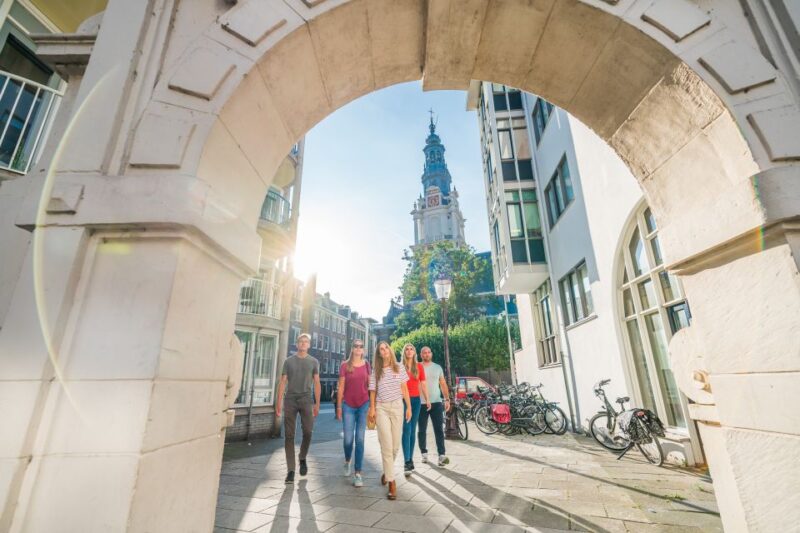
The canal belt was laid out to be walked. It is about three kilometres from the Brouwersgracht in the north to the Leidsegracht in the south, the bridges are low, and no point inside it is more than forty minutes on foot from Centraal Station. Three routes below cover most of what matters, and all three are free.
Three routes that work
| Route | How long | What you pass |
|---|---|---|
| The four canals crossing | About 1 hour | Start on the Brouwersgracht and cross the Singel, Herengracht, Keizersgracht and Prinsengracht in turn, ending at the Leidsegracht. The shortest way to understand how the belt was built. |
| The Golden Bend and the Nine Streets | About 1 hour 30 | The widest houses on the Herengracht, then west into the nine cross streets for shops and cafes, finishing at the Westerkerk and the Anne Frank House. |
| The oldest city | About 1 hour | Centraal Station down the Damrak to Dam Square, then east into De Wallen along the two Oudezijds canals, past the Oude Kerk and out at the Nieuwmarkt. |
Walking times from Centraal Station
| Destination | On foot | Alternative |
|---|---|---|
| De Wallen | 5 min | — |
| Dam Square | 10 min | Tram 2, stop Dam |
| The Nine Streets | 15 min | Tram 2, stop Keizersgracht |
| The Anne Frank House | 20 min | Tram 2, stop Prinsengracht |
| The Jordaan | 20 min | Tram 2, stop Prinsengracht |
| Rembrandtplein | 20 min | Metro 52, stop Vijzelgracht |
| Leidseplein | 30 min | Tram 2, stop Leidseplein |
| Museumplein | 40 min | Tram 2 or 5, 15 min |
Two things worth knowing
Cyclists have right of way over you almost everywhere, and the red asphalt is theirs, not yours — step off it. And the bridges over the main canals are the photograph everyone wants: stand on the bridge where the Reguliersgracht crosses the Herengracht and you can see fifteen bridges at once.
Where the routes go
| Neighbourhood | What you find there |
|---|---|
| The Red Light District | The oldest part of the city, built around two canals, five minutes from Centraal Station |
| The Nine Streets | Nine short streets crossing four canals: independent shops, cafes and 140 listed buildings |
| The Jordaan | The former workers’ quarter west of the Prinsengracht, with markets and hidden courtyards |
| Museumplein | The museum square: Rijksmuseum, Van Gogh, Stedelijk, Moco and the Concertgebouw |
| The Kalverstraat | The main shopping street, from Dam Square to the Munttoren |
When you want to stop walking
| Route | What it does |
|---|---|
| Tram line 2 | Centraal Station to the Museumplein across the canal belt in fifteen minutes |
| Metro line 52 | The blue line, under the old city from Noord to Zuid, with a free archaeological display at Rokin |
| Map of the canal district | How the four canals, the neighbourhoods and the tram routes fit together |
Useful to have
The walking itself costs nothing. These are only worth it if you are combining a walk with museums or want to ride back.
- GVB day ticket — for the ride back when your legs give out, from € 10.00.
- Canal cruise — an hour off your feet, seeing the same canals from the water.
- I amsterdam City Card — museums plus transport, if the walk is only half the day.
Yes, unusually so. The canal belt is about three kilometres from end to end and everything inside it is within forty minutes of Centraal Station on foot. Most visitors never need transport except to reach the Museumplein or Amsterdam Noord.
Crossing all four main canals from the Brouwersgracht to the Leidsegracht takes about an hour without stopping. Walking the length of one canal, the Prinsengracht, takes a similar hour.
For a first visit, cross the four canals rather than following one. You see the whole structure of the belt in an hour. For shops and cafes, walk the Nine Streets instead; for the oldest architecture, walk De Wallen along the two Oudezijds canals.
The bridge where the Reguliersgracht crosses the Herengracht. From there you can see fifteen bridges at once, and the view is lit after dark.
No. The canal belt is small, signposted and impossible to get lost in for long, because every canal eventually curves back towards the centre. A guide adds history, not navigation.
More to do
- Cycling — the same routes at three times the speed.
- Canal cruises — the same routes at water level.
- Everything to do — the full index.


