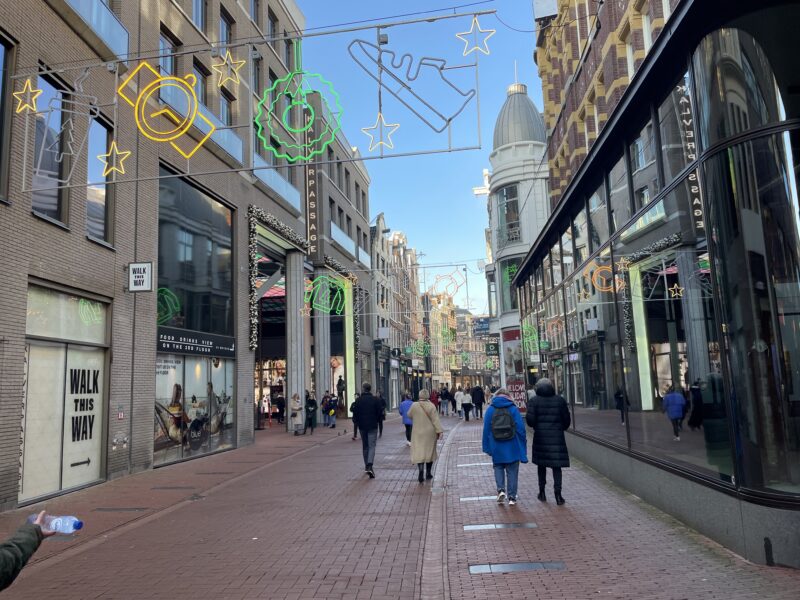
The Kalverstraat is Amsterdam’s main shopping street: 750 metres of pedestrianised chain stores running dead straight from Dam Square to the Munttoren, with more than 150 shops and around 50,000 people walking through on a normal day. It is also the most expensive retail street in the Netherlands. What almost nobody notices is that two of the quietest places in the old centre open directly off it.
The Kalverstraat at a glance
| Where | From Dam Square in the north to the Muntplein in the south, parallel to the Rokin |
| Length | About 750 metres, roughly a 10-minute walk end to end without stopping |
| From Centraal Station | About 10 minutes on foot along the Damrak, or tram 2, 4, 14, 17 or 24 to the Dam |
| Nearest metro | Rokin on line 52, at the southern end |
| Shops | More than 150, mostly international chains, plus the Kalvertoren shopping centre |
| What it costs | Nothing to walk. The Begijnhof and the hidden church on the street are both free |
| Best time to go | Weekday mornings before 11:00. Saturday afternoon is the busiest shopping moment of the week |
The street is named after the calf market that was held here until the seventeenth century, when the city was still small enough for cattle to be traded a few steps from the town hall on the Dam. Nothing of that survives at street level. What does survive is hidden behind the shopfronts: a Catholic church that had to pretend not to be one, a fourteenth-century courtyard, and the oldest wooden house in the city.
Opening hours on the street
| Day | Most shops |
|---|---|
| Monday | 11:00–18:00 |
| Tuesday, Wednesday, Friday | 10:00–18:00 |
| Thursday (late-night shopping) | 10:00–21:00 |
| Saturday | 10:00–18:00 |
| Sunday | 12:00–18:00 |
Walking south from the Dam
| # | Where | What is there | Book |
|---|---|---|---|
| 1 | Dam Square | The northern end. The Royal Palace, the Nieuwe Kerk, the National Monument and Madame Tussauds. | Madame Tussauds |
| 2 | Number 58 — De Papegaai | A full-sized Catholic church swallowed by the shopping street. Built as a clandestine church in 1672 when public Catholic worship was banned; the doorway onto the Kalverstraat was only cut in 1899. Free, open 10:00–16:00 except Sunday afternoon. | — |
| 3 | Number 92 — the Civic Orphanage | A carved sixteenth-century gateway leads into the Burgerweeshuis, the city orphanage that occupied this former convent from 1580 until 1960 and became the home of the Amsterdam Museum in 1975. | — |
| 4 | Begijnensteeg — the Begijnhof | An unmarked alley leading into a fourteenth-century courtyard of 164 houses, including Het Houten Huys at number 34, built in 1528 and the oldest wooden house in Amsterdam. Free. Daily 09:30–18:00 from February to October, 09:30–17:00 from November to January. | — |
| 5 | Spui | Bookshops, cafes and a book market on Fridays. The quiet counterweight to the chain stores. | — |
| 6 | Kalvertoren | An indoor shopping centre halfway down, with a glass lift to a rooftop cafe looking out over the old centre. | — |
| 7 | Muntplein | The southern end, marked by the Munttoren clock tower. The floating flower market on the Singel starts here. | — |
The two free stops nobody tells you about
The Kalverstraat has a reputation among Amsterdammers as the one street to avoid, and for shopping they have a point — the same chains trade in every European city. But the street is also the shortest route to two of the calmest places in the old centre, and both are free.
- De Papegaai, at number 58 — the largest surviving clandestine church in Amsterdam still in use. Step through the door and the noise of the street stops completely. Look for the parrot above the entrance: the original owner was a bird trader, which is where the nickname comes from.
- The Begijnhof, through the Begijnensteeg — a walled courtyard where beguines lived from the fourteenth century. It holds the English Reformed Church, in English-speaking use since 1607, and a chapel from 1671 where Catholics worshipped in secret until 1795. It is still residential, so visitors are asked to keep their voices down and stay out after closing time.
What to book near the Kalverstraat
The street itself sells clothes, not tickets. The attractions worth booking are at either end: Madame Tussauds on the Dam at the north end, and the Amsterdam Dungeon on the Rokin, one block east of the middle. Both sell out on rainy weekend afternoons, which is exactly when you will want them.
- Madame Tussauds Amsterdam — on Dam Square at the top of the street, with a view over the square from the upper floor.
- The Amsterdam Dungeon — live actors and the darker side of Amsterdam history, on the Rokin one street east.
- I amsterdam City Card — free entry to most city museums plus unlimited GVB transport.
- Go City Amsterdam pass — bundles the big attractions including a canal cruise, useful if you are visiting several in a few days.
Staying here
Booking.com currently lists 206 places to stay in this district. Staying inside the neighbourhood you came for saves you the two tram rides a day that eat into a short trip.
- Browse hotels in this district — Count from Booking.com, August 2026. The link carries our partner code and costs you nothing extra.
The Kalverstraat is the main shopping street of Amsterdam, a pedestrianised street of about 750 metres running from Dam Square to the Muntplein. It has more than 150 shops, mostly international chains, and is the most expensive retail street in the Netherlands.
It is about 750 metres long, which is a ten-minute walk from end to end if you do not stop. With shops and crowds, most visitors take considerably longer.
Most shops open at 10:00 from Tuesday to Saturday, at 11:00 on Monday and at 12:00 on Sunday, and close at 18:00. Thursday is late-night shopping, when shops stay open until 21:00.
Yes, at number 58. De Papegaai, officially the Church of St Peter and St Paul, is a clandestine Catholic church built in 1672, when public Catholic worship was forbidden. Its entrance onto the Kalverstraat was only created in 1899. Entry is free and it is open from 10:00 to 16:00 except on Sunday afternoon.
Take the Begijnensteeg, a narrow unmarked alley off the Kalverstraat near the Spui. The courtyard is free to enter and open daily from 09:30, until 18:00 between February and October and until 17:00 from November to January.
For shopping, only if you want the international chains, which you can find at home. For everything else it is worth the ten minutes: it is the fastest route from Dam Square to the flower market, and the Begijnhof and De Papegaai open directly off it. For independent shops, walk one canal west to the Nine Streets instead.
Around the Kalverstraat
- The Red Light District — the oldest part of the city, five minutes east across the Damrak.
- The Nine Streets — independent shops and cafes in the canal belt, ten minutes west and a completely different kind of shopping.
- Museumplein — the museum square, fifteen minutes south by tram 2 or 24.
- Map of the canal district — where the Kalverstraat runs in relation to the canals.
- Metro line 52 — the Noord/Zuidlijn, under the old city in fifteen minutes, with a free archaeological display inside Rokin station.
Read more: our full guide to hotels in this district.


